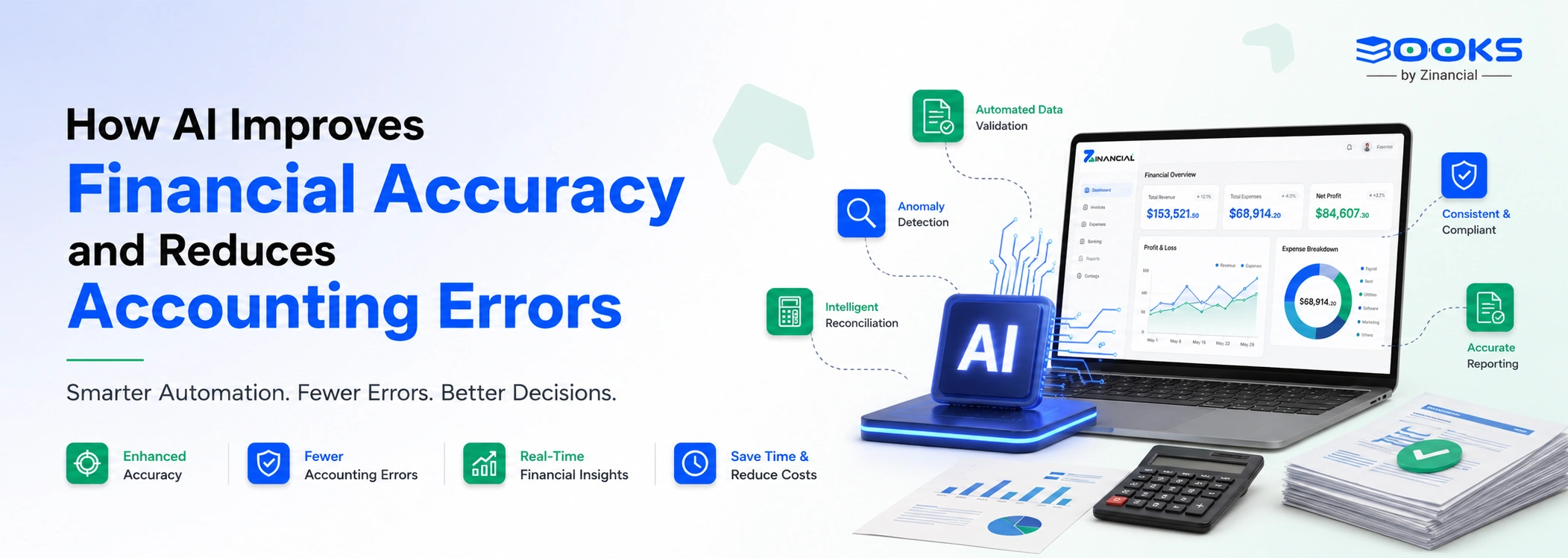
AI is not just improving one part of finance. It is strengthening accuracy across multiple layers, from data entry and validation to forecasting and compliance. T
he real value of AI financial accuracy comes from how these systems work together to reduce errors, standardize processes, and deliver reliable financial data in real time.
1. Error Reduction in Financial Processes
Manual processes are still the biggest source of financial inaccuracies. Even small data entry mistakes can lead to reconciliation issues, reporting errors, and compliance risks.
This is where AI bookkeeping makes a measurable difference.
AI systems:
- Capture transaction data automatically from multiple sources
- Classify entries using trained models instead of manual rules
- Flag inconsistencies instantly instead of at the end of a cycle
This leads to consistent error reduction across key processes like journal entries, invoice matching, and account reconciliation.
What changes here is not just speed, it is the removal of human dependency in repetitive tasks. AI ensures that the same logic is applied every time, across all transactions.
This is where modern AI-powered platforms come in. Tools like Zinancial Books automate transaction capture and classification, ensuring consistent error reduction without manual dependency.
Instead of fixing errors during closing, finance teams prevent them at the point of entry.
2. Real-Time Accounting Accuracy
Traditional accounting workflows rely on delayed validation. Data is reviewed after processing, which leads to last-minute corrections.
AI changes this completely.
If you look at how AI improves accounting accuracy, the biggest shift is real-time validation.
AI systems:
- Continuously monitor transactions as they occur
- Detect duplicates, anomalies, and missing data instantly
- Sync financial data across systems without lag
This ensures that financial records remain clean throughout the cycle, not just at the end.
For finance teams, this reduces:
- Back-and-forth during closing
- Manual adjustments
- Dependency on audits to catch errors
Real-time validation improves both speed and confidence in financial reporting.
3. Fraud Detection and Prevention
Financial accuracy is not only about correct entries. It is also about identifying what should not be there.
AI has significantly improved fraud detection by shifting from rule-based systems to behavioral intelligence.
Modern AI systems:
- Track user behavior like keystrokes and access patterns
- Monitor transaction timing, frequency, and deviations
- Use voice recognition and identity verification tools
AI-led accounting platforms, including Zinancial Books, are increasingly embedding anomaly detection to flag unusual patterns early and maintain cleaner financial data.
By improving fraud detection, AI ensures that only valid transactions enter financial systems. That directly strengthens AI financial accuracy.
4. Financial Reporting and Closing
Financial reporting is where accuracy issues become visible. Even minor inconsistencies can delay closing and impact decision-making.
With automated accounting, AI simplifies and standardizes reporting workflows.
AI helps:
- Automate expense categorization and journal entries
- Match transactions across systems without manual effort
- Maintain consistent reporting formats
This leads to:
- Faster month-end closes
- Fewer reconciliation errors
- More reliable financial statements
Finance teams no longer need to spend days correcting mismatches or verifying entries manually. Instead, they work with cleaner data from the start. This improves both internal reporting accuracy and external compliance readiness.
5. Forecasting and Predictive Accuracy
Forecasting has traditionally depended on limited datasets and manual analysis. That approach often leads to inaccurate projections.
AI changes the scale and depth of analysis.
AI models:
- Combine historical and real-time financial data
- Identify trends that are not visible through manual analysis
- Continuously update predictions as new data comes in
This improves:
- Budgeting accuracy
- Cash flow predictions
- Financial planning decisions
Instead of relying on static reports, finance teams get dynamic forecasts that adjust in real time. PwC reports that AI-powered forecasting models can achieve up to 95%–99.5% accuracy, significantly improving the reliability of financial predictions.
This is one of the most impactful ways how AI improves accounting accuracy, by extending accuracy beyond reporting into decision-making.
6. Agentic Financial Operations
One of the biggest shifts in 2026 is the rise of agentic AI. These systems go beyond automation. They can execute tasks independently and manage complex workflows.
AI agents can:
- Handle multi-step financial processes
- Optimize capital allocation decisions
- Support financial planning and analysis
This reduces the need for constant manual intervention. For example, instead of manually reconciling accounts or adjusting forecasts, AI agents can perform these tasks continuously and accurately.
This shift is already visible in platforms like Zinancial Books, which automate multi-step financial workflows and reduce manual intervention.
This improves consistency across financial operations and reduces human-driven variability. As a result, AI bookkeeping becomes more scalable and reliable.
7. Compliance and Audit Accuracy
Compliance is one of the most sensitive areas in finance. Errors here can lead to penalties and reputational risks. AI strengthens compliance by embedding validation directly into workflows.
AI systems:
- Monitor regulatory requirements continuously
- Automatically apply compliance rules to transactions
- Maintain detailed audit trails
This improves:
- Accuracy in regulatory reporting
- Audit readiness
- Transparency across financial records
Unlike traditional audits that rely on sampling, AI can review entire datasets. This increases the depth and reliability of audits. Finance teams can move from reactive compliance to proactive risk management.
8. Operational Efficiency and Accuracy
There is often a trade-off between speed and accuracy. AI removes that trade-off.
With automated accounting, finance teams can:
- Process large volumes of transactions quickly
- Maintain consistency across systems
- Reduce manual workload
This leads to improved operational efficiency without sacrificing accuracy. In fact, efficiency and accuracy now go hand in hand. AI ensures that faster processes do not introduce more errors. Instead, they reduce them.
This is critical for scaling finance operations in growing organizations.