Every business owner looks at revenue. Fewer truly understand what the numbers are saying beneath it. A profit and loss statement is not just an accounting document. It is a decision tool. It shows whether your operations are sustainable, where money is leaking, and how efficiently you convert revenue into profit.
Many founders review a P&L report only during tax season. That is a mistake. Strong financial reporting habits directly influence growth decisions. According to the Global CEO Outlook by KPMG, 73 percent of CEOs say data-driven insights are critical to long-term performance. Financial clarity starts with understanding your numbers at the core level.
If you have ever searched for what is a profit and loss statement, what is P&L, or how to read a P&L statement, this guide breaks it down clearly and practically – whether you’re running a P&L statement for small business operations or a P&L statement for ecommerce.
In plain terms: a profit and loss statement adds up how much money a business earned and spent during a specific period, then shows whether that left a profit or a loss.
A P&L statement also goes by several other names – you’ll see it called an income statement, a statement of operations, a statement of financial results, an earnings statement, or simply a pnl statement. They’re all the same report; the label just depends on who’s using it.
Key takeaways:
- A profit and loss statement (also called a p and l statement or pnl statement) shows whether your business made or lost money over a set period.
- It is one of three core financial reports, alongside the balance sheet and cash flow statement.
- Learning how to create a profit and loss statement – and reading it correctly – is one of the highest-leverage habits a founder can build.
A profit and loss statement summarizes revenue, expenses, and net income over a specific period. Monthly. Quarterly. Annually. It answers one simple question: did the business make money?
What does P&L stand for? Simply “profit and loss” – and you’ll often see it referred to interchangeably as a P&L, a pnl statement, or an income statement. They’re the same document; the name just varies by convention (public companies and accountants often say “income statement,” small business owners tend to say “P&L”).
Also Read: Best Financial Reporting Software in 2026
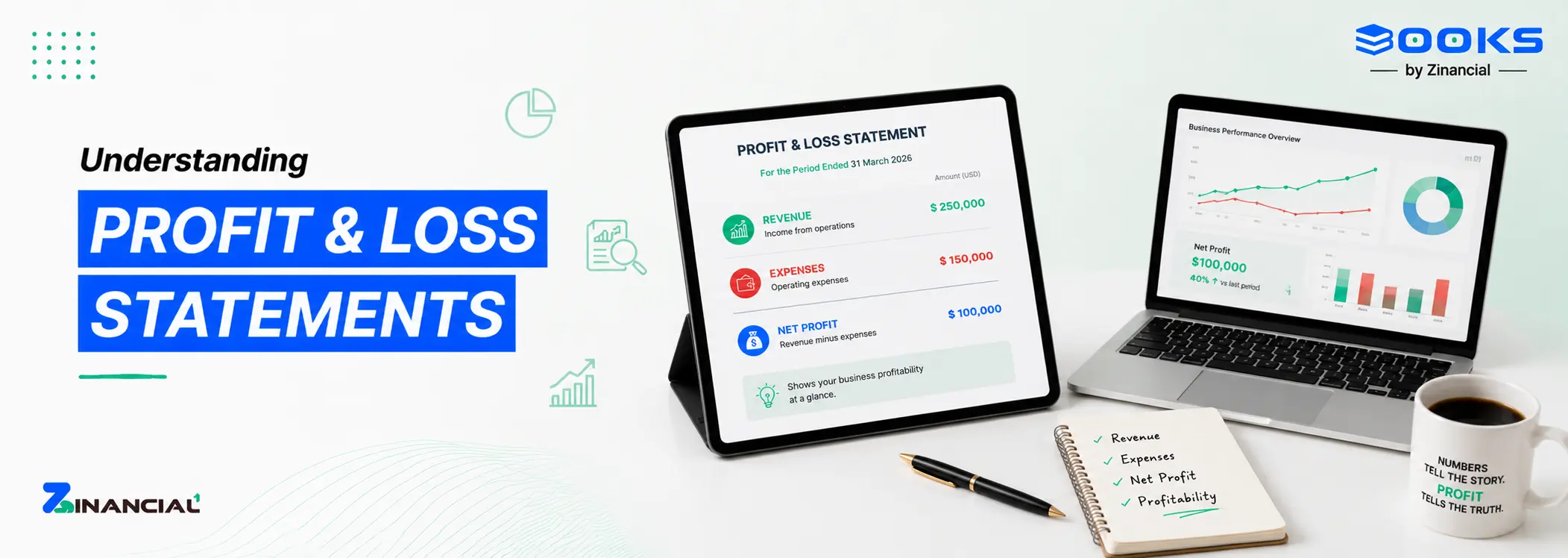
At its most basic, the structure of a simple profit and loss statement looks like this:
Revenue alone means nothing without context. A growing top line with shrinking margins signals a deeper issue. That is why consistent financial reporting is non-negotiable for scaling businesses.
Platforms like Zinancial Books make this analysis easier, turning raw P&L data into clear insights you can actually use.
Make your P&L a management tool.
Tired of rebuilding this P&L by hand every month?
Zinancial Books turns your transactions into an updated profit and loss statement automatically — no spreadsheets, no manual math, just numbers you can trust.
See Your P&L in Real Time