Zinancial

Get Early Access at $25/month

Zinancial Books
Featured Blog

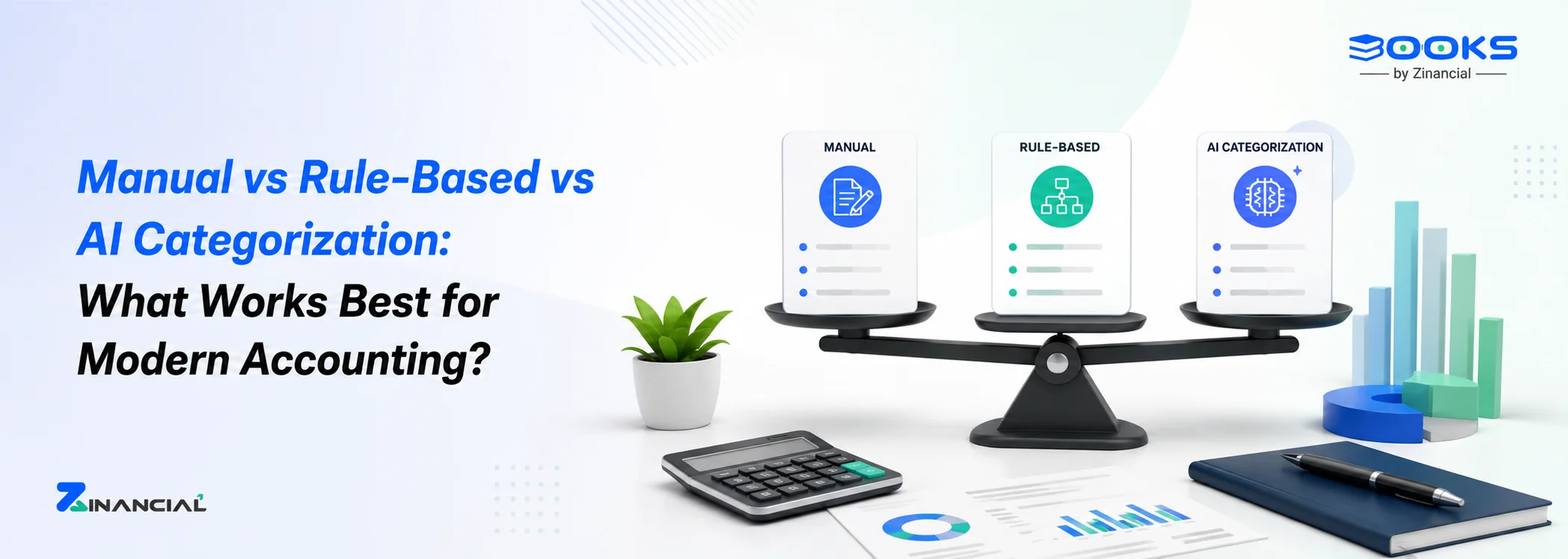
Manual vs Rule-Based vs AI Categorization: What Works Best for Modern Accounting?

Harsh Raj
Written byZinancial TeamEdited on 30 Jul, 2026
Manual vs Rule-Based vs AI Categorization: What Works Best for Modern Accounting?
Article summary

Article Summary

This should save you ~10 minutes of reading

AI categorization automatically classifies financial transactions using historical patterns, while rule-based accounting relies on predefined rules such as vendors, keywords, or transaction types.

Compared with rule-based systems, AI-driven categorization adapts to new transaction patterns, improves bookkeeping accuracy, and reduces manual intervention.

Modern accounting platforms combine AI and rule-based categorization to automate transaction processing, improve financial reporting consistency, and efficiently manage high transaction volumes.

Every financial report begins with one critical task. Categorizing transactions correctly. 

A misplaced expense can distort financial reports, impact tax calculations, and weaken forecasting accuracy. That is why many businesses now rely on automated categorization instead of manual bookkeeping. 

Today, finance teams typically use three approaches. Manual categorization, rule-based accounting, or modern AI categorization. 

Each approach offers different levels of speed, accuracy, and scalability. The differences become clear as transaction volumes increase. 

Understanding AI vs rule-based transaction categorization helps businesses choose the most effective system for accurate and scalable accounting. 

Start With Manual Categorization

Manual categorization is the traditional accounting method. An accountant reviews each transaction and assigns the correct category. 

This approach works well for businesses with limited transaction volume. Early-stage companies often begin with manual processes because there is little setup required. 

However, the system becomes difficult to manage as financial activity grows. 

Common challenges include: 

  • Time-consuming bookkeeping 
  • Inconsistent categorization across accountants 
  • Higher risk of human error 
  • Delayed financial reporting 

Two accountants may categorize the same transaction differently. Over time, these inconsistencies can distort financial insights. 

Manual categorization also slows down reporting cycles. Financial statements cannot be finalized until all transactions are reviewed. 

This is where accounting automation becomes valuable. By shifting toward automated categorization, finance teams reduce manual work and improve consistency. 

Modern accounting tools such as Zinancial Books streamline bookkeeping by automatically organizing transactions into the correct categories. 

Use Rule-Based Accounting for Basic Automation

The next stage of financial automation is rule-based accounting. 

Instead of categorizing transactions manually, accountants create predefined rules that assign categories automatically. 

For example:

  • Transactions from Stripe → Payment Processing Fees 
  • Transactions containing “Uber” → Travel Expense 
  • Vendor name matches → Office Supplies 

These rules allow systems to perform automated categorization quickly and consistently. 

Here is how rule-based categorization typically works. 

Rule Condition Example Transaction Assigned Category
Vendor name match Amazon Business Office Supplies
Payment processor Stripe payout Payment Processing Fees
Keyword detection Uber trip Travel Expense
Bank memo pattern AWS billing Cloud Infrastructure

While rule-based accounting improves efficiency, it still comes with limitations. 

Typical challenges include: 

  • Every rule must be created manually 
  • New vendors require new rules 
  • Slight variations in transaction descriptions break rules 
  • Rule libraries require ongoing maintenance 

As businesses grow, rule management becomes increasingly complex. 

This is where AI categorization begins to outperform rule systems. Instead of relying solely on predefined rules, AI systems learn from historical financial data. 

Modern platforms like Zinancial Books combine rule systems with accounting automation to reduce the burden of rule maintenance. 

Scale Financial Operations With AI Categorization

AI categorization represents the most advanced approach to transaction classification. 

Unlike rule systems, AI does not rely entirely on predefined logic. Instead, it analyzes historical data and learns how transactions are categorized. 

AI systems continuously learn from historical transaction patterns and improve classification accuracy over time. This reduces the need for manual rule creation and ongoing maintenance. This learning process dramatically improves automated categorization accuracy. 

A Deloitte Finance Trends survey found that 63% of finance teams have already deployed and actively use AI solutions in their departments.  

AI systems can evaluate multiple factors such as: 

  • Vendor behavior 
  • Transaction descriptions 
  • Spending patterns 
  • Historical accounting entries 

Because of this, AI categorization can correctly classify transactions even when descriptions vary. 

Key advantages include: 

  • Adapts to new transaction patterns 
  • Improves accuracy over time 
  • Reduces manual rule creation 
  • Handles complex transaction descriptions 

These capabilities are why discussions around AI vs rule-based transaction categorization are becoming more common in finance teams. 

Instead of managing hundreds of rules, businesses can rely on systems that learn and improve continuously. 

Tools such as Zinancial Books apply advanced accounting automation and AI categorization to manage large transaction volumes with consistent accuracy. 

Understand How Categorization Methods Have Evolved

Transaction categorization has evolved significantly over time. 

It started with manual effort, progressed to rigid rule-based systems, and now relies on intelligent AI-driven automation. 

Each approach performs best in different situations. 

  • Manual categorization works best for low-volume transactions requiring human judgment. 
  • Rule-based accounting performs well in predictable and repetitive environments. 
  • AI categorization excels when handling high-volume, unstructured, or complex transaction data. 

As transaction volumes grow, many businesses move toward automated categorization powered by accounting automation. Manual bookkeeping struggles to keep up with this level of activity. An EY Corporate Treasury Survey found that 82% of organizations are planning or actively progressing toward AI adoption. 

Accounting systems such as Zinancial Books combine AI intelligence with automated categorization to maintain consistent financial records. 

Comparison of Manual, Rule-Based, and AI Categorization

The differences become clearer when comparing these approaches across speed, flexibility, and maintenance. 

Feature Manual Categorization Rule-Based Categorization AI Categorization
Speed Slow Very Fast Fast and scalable
Accuracy Prone to human error High if rules are perfect Very high (>99%)
Flexibility High, handles nuance Low, rigid rules High, adapts to change
Setup Effort Low initially High, defining rules High, training and data
Maintenance High recurring labor High due to rule updates Low, systems improve automatically
Best For Small or unique datasets Stable and repetitive tasks Complex and high-volume data

This comparison explains the growing interest in AI vs rule-based transaction categorization. 

AI systems continue improving as they process more data, making them highly scalable for modern financial operations. 

Choose the Right Categorization System for Growth

Manual categorization works well for very small datasets but becomes inefficient as businesses grow. 

Rule-based accounting improves efficiency through predefined automation but still requires ongoing maintenance. 

The most scalable approach today is AI categorization, which learns from financial data and continuously improves accuracy. 

When comparing AI vs rule-based transaction categorization, AI offers stronger scalability, adaptability, and efficiency. 

Solutions such as Zinancial Books bring together AI categorization, automated categorization, and powerful accounting automation to keep financial records accurate and structured. 

The result is faster reporting, cleaner books, and better financial decision-making. 

FAQs
Frequently Asked Questions

Quick answers to common questions about this topic.

What is AI categorization in accounting?

AI categorization uses machine learning to automatically classify financial transactions based on historical patterns and transaction data.

How does rule-based accounting work?

Rule-based accounting categorizes transactions using predefined rules such as vendor names, keywords, or transaction types.

What is AI vs rule-based transaction categorization?

This comparison explains how rule systems rely on fixed logic, while AI systems learn from financial data and adapt to new transaction patterns.

Does Zinancial Books support AI transaction categorization?

Yes. Zinancial Books uses intelligent AI categorization to automatically classify transactions and improve bookkeeping accuracy.

How does Zinancial Books improve accounting automation?

Zinancial Books combines AI categorization and automated categorization to organize transactions and reduce manual bookkeeping work.

Can Zinancial Books reduce manual bookkeeping?

Yes. Zinancial Books automates transaction categorization, allowing finance teams to spend less time on manual data entry.

Does Zinancial Books support rule-based accounting?

Yes. Zinancial Books supports rule-based accounting while also offering AI-driven categorization for greater flexibility.

Is Zinancial Books suitable for businesses with high transaction volumes?

Yes. Zinancial Books uses automated categorization and accounting automation to handle large transaction datasets efficiently.

How does Zinancial Books improve financial reporting accuracy?

By using AI categorization, Zinancial Books ensures transactions are consistently classified, improving report accuracy.

Can Zinancial Books adapt to new transaction patterns?

Yes. The AI-driven categorization system in Zinancial Books learns from historical financial data and adapts to new transaction behaviors.

Still have questions?

We are here to answer any question you may have.

Ask a Question

Our Recent Blog

5 Best Financial Statement Generator for Startups & SMBs in 2027
26 Oct, 2026Books

5 Best Financial Statement Generator for Startups & SMBs in 2027

A financial statement generator helps turn accounting data into clear reports, so you can understand your business finances without spending hours sorting through spreadsheets. For startups and SMBs, the right tool can simplify reporting, reduce manual work, and help answer important questions about profitability, cash flow, and financial health. However, features, accuracy, and costs vary […]

Read More...
Best Financial Reporting Software for 2027: 10 Tools Compared (With Pricing)
12 Aug, 2026Books

Best Financial Reporting Software for 2027: 10 Tools Compared (With Pricing)

If you have ever stayed late closing the books, you know the drill. You pull numbers from five different tabs and cross-check formulas that break the moment someone edits a cell. You send the report to your boss, then find an error an hour later. Financial reporting software exists to end that cycle. The right […]

Read More...
Top 7 Expense Reporting Software Platforms in 2026
7 Aug, 2026Books

Top 7 Expense Reporting Software Platforms in 2026

You have paid for lunch with a client, uploaded the receipt, and submitted your expense report. Days later, it is still awaiting approval, reimbursement is delayed, and finance is following up on missing details. Expense reporting software is designed to eliminate those bottlenecks. It automates receipt capture, approvals, and expense tracking, helping businesses save time […]

Read More...
Engineered by the Best in the Business - Zinancial call to action banner

Engineered by the Best in the Business

Zinancial is built by professionals who understand accounting challenges, modern software, and especially what growing businesses need.