Zinancial

Get Early Access at $25/month

Zinancial Books
Featured Blog

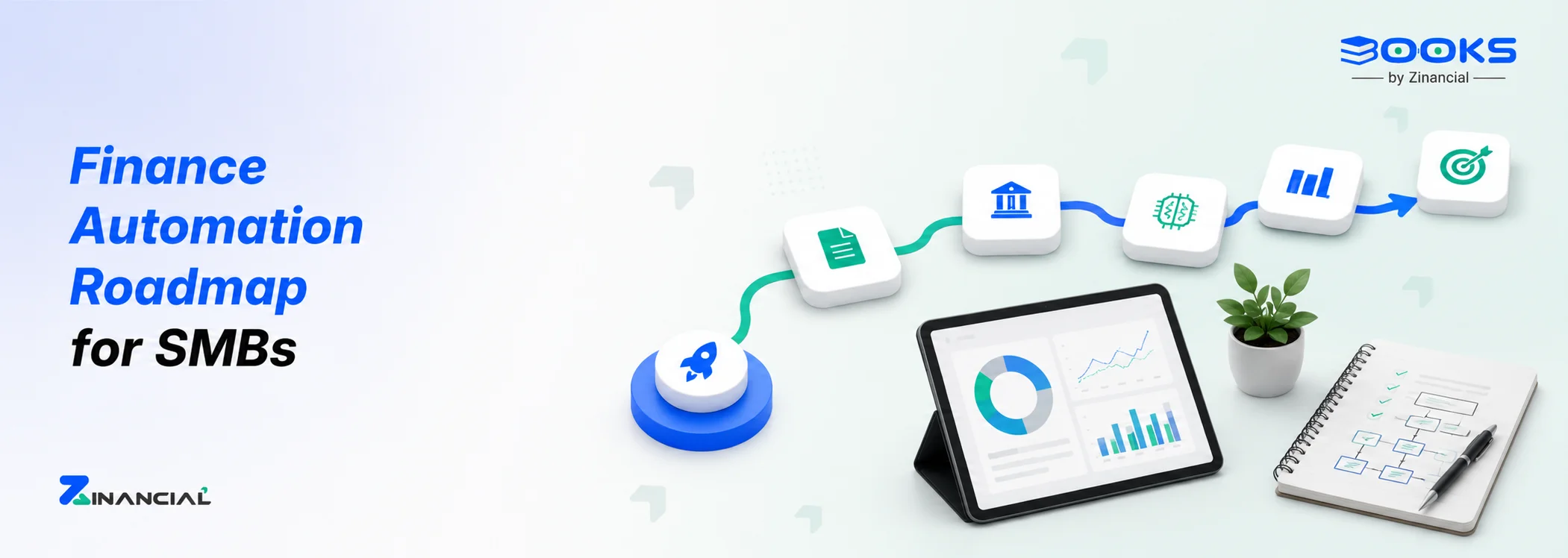
Finance Automation Roadmap for SMBs

Harsh Raj
Written byZinancial TeamEdited on 30 Jul, 2026
Finance Automation Roadmap for SMBs
Article summary

Article Summary

This should save you ~10 minutes of reading

Finance automation helps SMBs automate repetitive accounting tasks, reduce errors, and improve financial efficiency.

A finance automation roadmap should start with process assessment, followed by technology implementation and AI-driven optimisation.

The first processes to automate are accounts payable, accounts receivable, expense management, bank reconciliation, and financial reporting.

If your finance team still depends on spreadsheets, emails, and manual approvals, you are already feeling the strain. Delays, errors, and lack of visibility start compounding as you grow. This is exactly where finance automation changes the game. 

For small and mid-sized businesses, the shift is not about replacing people. It is about removing repetitive work so your team can focus on decisions that actually move the business forward. A structured finance automation roadmap helps you do this in a controlled, measurable way. 

According to PwC, leading finance teams have reduced their costs by nearly 25% by automating processes and shifting focus from manual tasks to strategic insights. 

What Is Finance Automation for SMBs?

At a basic level, finance automation means using technology to handle routine financial tasks. This includes invoicing, expense tracking, reconciliations, reporting, and approvals. 

For SMBs, the benefits show up quickly. 

Manual processes are slow. They rely heavily on human input, which increases the risk of errors. They also create bottlenecks, especially during month-end or audit cycles. With accounting automation, these workflows become structured and consistent. 

Here is what changes when you implement it: 

  • Tasks that took hours get completed in minutes  
  • Data flows automatically between systems  
  • Errors are reduced through standardization  
  • Reports are generated in real time  
  • Compliance becomes easier to manage  

What this really means is simple. You gain control over your finances without increasing your team size. That is the real value of SMB automation. 

What Should SMBs Automate First?

A common mistake is trying to automate everything at once. That usually leads to confusion and low adoption. A smarter approach is to focus on high-impact areas first. 

Your finance automation roadmap should begin with processes that are repetitive, time-consuming, and prone to errors. 

Start with these core areas: 

Accounts Payable (AP) 

  • Invoice capture and data entry  
  • Approval workflows  
  • Payment scheduling  

Accounts Receivable (AR) 

  • Invoice generation  
  • Payment reminders  
  • Cash application  

Expense Management

  • Receipt capture  
  • Policy validation  
  • Reimbursements  

Bank Reconciliation 

  • Automatic transaction matching  
  • Exception identification  

Financial Reporting 

  • Report automation  

These areas deliver quick wins. They also build confidence in accounting automation, making it easier to expand into more complex workflows later. 

Phase 1: Assessment and Foundation (Months 1–3)

Every effective finance automation roadmap starts with clarity. Before you introduce any tools, you need to understand your current state. 

Evaluate Your Existing Processes 

Look closely at your finance workflows. 

  • Which tasks are manual?  
  • Where do delays occur?  
  • Which processes require repeated follow-ups?  

Invoice processing and expense reporting are usually the biggest time drains. These are strong candidates for early finance automation. 

Map Your Data Flows 

Understanding how data moves is critical. 

  • Where does financial data originate?  
  • How is it transferred between systems?  
  • Where does duplication or inconsistency occur?  

Many SMBs discover hidden inefficiencies at this stage. Manual uploads, disconnected tools, and inconsistent formats create friction. Addressing these early strengthens your finance automation roadmap. 

Set Clear, Measurable Goals 

You need specific outcomes to track success. 

For example: 

  • Reduce manual finance tasks from 40% to under 20%  
  • Cut invoice processing time by half  
  • Shorten month-end closing cycles by 30%  

These targets ensure your SMB automation efforts stay focused and measurable. 

Phase 2: Technology Adoption and Integration (Months 3–9)

This is where your roadmap moves from planning to execution. The focus here is on implementing systems that support finance automation at scale. 

Move to Cloud-Based Systems 

Cloud platforms are essential for modern finance operations. 

They allow: 

  • Real-time access to financial data  
  • Automatic updates and backups  
  • Seamless integrations across tools  

This shift lays the foundation for effective accounting automation. Solutions such as Zinancial Books are designed with this flexibility in mind. They help SMBs transition smoothly into accounting automation without disrupting existing workflows. 

Automate Core Finance Functions 

Start with the processes you identified earlier. 

  • Accounts Payable automation reduces manual invoice handling and speeds up approvals. It also improves vendor relationships by ensuring timely payments. 
  • Accounts Receivable automation ensures invoices are sent on time and payments are tracked efficiently. Automated reminders reduce delays and improve cash flow. 
  • Expense Management automation eliminates manual tracking. Receipts are captured digitally, and policies are enforced automatically. 

These changes may seem operational, but they have a direct impact on efficiency and accuracy. This is where SMB automation starts delivering visible results. 

Integrate Systems for Real-Time Visibility 

Automation without integration creates silos. 

Your systems need to work together. Financial data should flow seamlessly between accounting, banking, and operational tools. This ensures that your reports reflect real-time information. 

A strong finance automation roadmap prioritizes integration early. It prevents duplication, reduces errors, and gives you a single source of truth. 

Phase 3: AI Enhancement and Optimization (Months 9–15)

Once your systems are in place, the next step is optimization. This is where finance automation moves beyond efficiency and starts enabling better decisions. 

Use Data for Forecasting 

With automated systems in place, you now have access to reliable data. 

You can use this data to: 

  • Forecast cash flow  
  • Identify spending trends  
  • Plan for future investments  

This shift from reactive to proactive finance is a key benefit of SMB automation. 

Continuously Improve Workflows 

Automation is not a one-time effort. 

You need to: 

  • Monitor performance metrics  
  • Identify inefficiencies  
  • Refine workflows regularly  

Start with pilot programs. Test new processes on a smaller scale before expanding. This reduces risk and improves adoption. 

A strong finance automation roadmap evolves as your business grows. 

Common Challenges in SMB Automation

While the benefits are clear, implementation is not always straightforward. 

Resistance to Change 

Teams may be hesitant to adopt new systems. 

Solution:
Involve them early. Show how finance automation reduces repetitive work and improves efficiency. 

Poor Data Quality 

Automation depends on clean data. Inconsistent inputs lead to unreliable outputs. 

Solution:
Standardize data formats before implementing accounting automation. 

Overcomplicating the Process 

Too many tools can create confusion. 

Solution:
Use unified platforms like Zinancial Books that align with your finance automation roadmap and reduce system sprawl. 

Lack of Strategy 

Jumping into automation without a plan leads to fragmented systems. 

Solution:
Follow a phased approach. Align every step with clear business goals. 

How Finance Automation Improves Cash Flow

Cash flow is one of the most immediate areas of impact. 

With finance automation: 

  • Invoices are generated and sent instantly  
  • Payment reminders are automated  
  • Transactions are tracked in real time  

This reduces delays and improves predictability. 

Better visibility also helps you make informed decisions. You can identify potential gaps early and take action before they become problems. This is where SMB automation becomes a strategic advantage. 

The Role of Accounting Automation in the Bigger Picture

Accounting automation is the foundation of your broader strategy. 

It ensures that: 

  • Transactions are recorded accurately  
  • Data is categorized consistently  
  • Reports reflect real-time information  

Without this layer, your finance automation roadmap cannot function effectively. 

Think of it as the engine behind your finance operations. It powers everything from reporting to forecasting. 

How Zinancial Supports Your Finance Automation Journey

This is where execution matters. 

Zinancial helps SMBs move from manual processes to structured finance automation without unnecessary complexity. 

With Zinancial, you get: 

  • End-to-end support in building a finance automation roadmap  
  • Integrated accounting automation systems  
  • Scalable solutions tailored for growing businesses  

Instead of piecing together multiple tools, you get a unified system that supports your growth. 

Build a Roadmap That Works for You

A successful finance automation roadmap is not about speed. It is about structure. 

Start with a clear understanding of your current processes. Focus on high-impact areas. Implement in phases. Continuously refine your approach. 

This is how finance automation delivers lasting value. 

For SMBs, the goal is not just efficiency. It is building a finance function that can scale with the business. With the right approach to SMB automation, that goal becomes achievable. 

FAQs
Frequently Asked Questions

Quick answers to common questions about this topic.

What is finance automation and how does it help SMBs?

Finance automation uses software to handle repetitive finance tasks like invoicing, reconciliations, and reporting. For SMBs, it reduces errors, saves time, and improves decision-making.

How do I build a finance automation roadmap for my business?

Start by assessing current processes, identify high-impact areas, adopt the right tools, and implement changes in phases. A structured finance automation roadmap ensures long-term success.

What is the difference between finance automation and accounting automation?

Finance automation covers the entire finance function, while accounting automation focuses on recording, categorizing, and reporting financial transactions.

How does Zinancial Books support finance automation for SMBs?

Zinancial Books helps SMBs implement finance automation by streamlining workflows, integrating systems, and providing real-time financial visibility tailored to business needs.

Can Zinancial Books help create a finance automation roadmap?

Yes, Zinancial Books works closely with SMBs to design and implement a customized finance automation roadmap based on their current processes and growth goals.

Does Zinancial Books support accounting automation?

Zinancial Books offers robust accounting automation capabilities, including automated entries, reconciliations, and reporting to ensure accuracy and efficiency.

How does Zinancial Books improve cash flow management?

By automating invoicing, payment tracking, and reminders, Zinancial Books helps businesses improve collections and gain better visibility into cash flow.

Is Zinancial Books suitable for small and growing businesses?

Yes, Zinancial Books is designed specifically for SMBs, offering scalable solutions that adapt as your business grows and your SMB automation needs evolve.

How long does it take to implement Zinancial Books for finance automation?

Implementation timelines vary, but most SMBs can start seeing benefits within a few weeks, especially for core finance automation functions like AP and AR.

Can Zinancial Books integrate with existing systems?

Yes, Zinancial Books integrates with your existing tools and systems, ensuring a smooth transition and supporting a connected finance automation roadmap.

Still have questions?

We are here to answer any question you may have.

Ask a Question

Our Recent Blog

5 Best Financial Statement Generator for Startups & SMBs in 2027
26 Oct, 2026Books

5 Best Financial Statement Generator for Startups & SMBs in 2027

A financial statement generator helps turn accounting data into clear reports, so you can understand your business finances without spending hours sorting through spreadsheets. For startups and SMBs, the right tool can simplify reporting, reduce manual work, and help answer important questions about profitability, cash flow, and financial health. However, features, accuracy, and costs vary […]

Read More...
Best Financial Reporting Software for 2027: 10 Tools Compared (With Pricing)
12 Aug, 2026Books

Best Financial Reporting Software for 2027: 10 Tools Compared (With Pricing)

If you have ever stayed late closing the books, you know the drill. You pull numbers from five different tabs and cross-check formulas that break the moment someone edits a cell. You send the report to your boss, then find an error an hour later. Financial reporting software exists to end that cycle. The right […]

Read More...
Top 7 Expense Reporting Software Platforms in 2026
7 Aug, 2026Books

Top 7 Expense Reporting Software Platforms in 2026

You have paid for lunch with a client, uploaded the receipt, and submitted your expense report. Days later, it is still awaiting approval, reimbursement is delayed, and finance is following up on missing details. Expense reporting software is designed to eliminate those bottlenecks. It automates receipt capture, approvals, and expense tracking, helping businesses save time […]

Read More...
Engineered by the Best in the Business - Zinancial call to action banner

Engineered by the Best in the Business

Zinancial is built by professionals who understand accounting challenges, modern software, and especially what growing businesses need.