Zinancial

Get Early Access at $25/month

Zinancial Books
Featured Blog

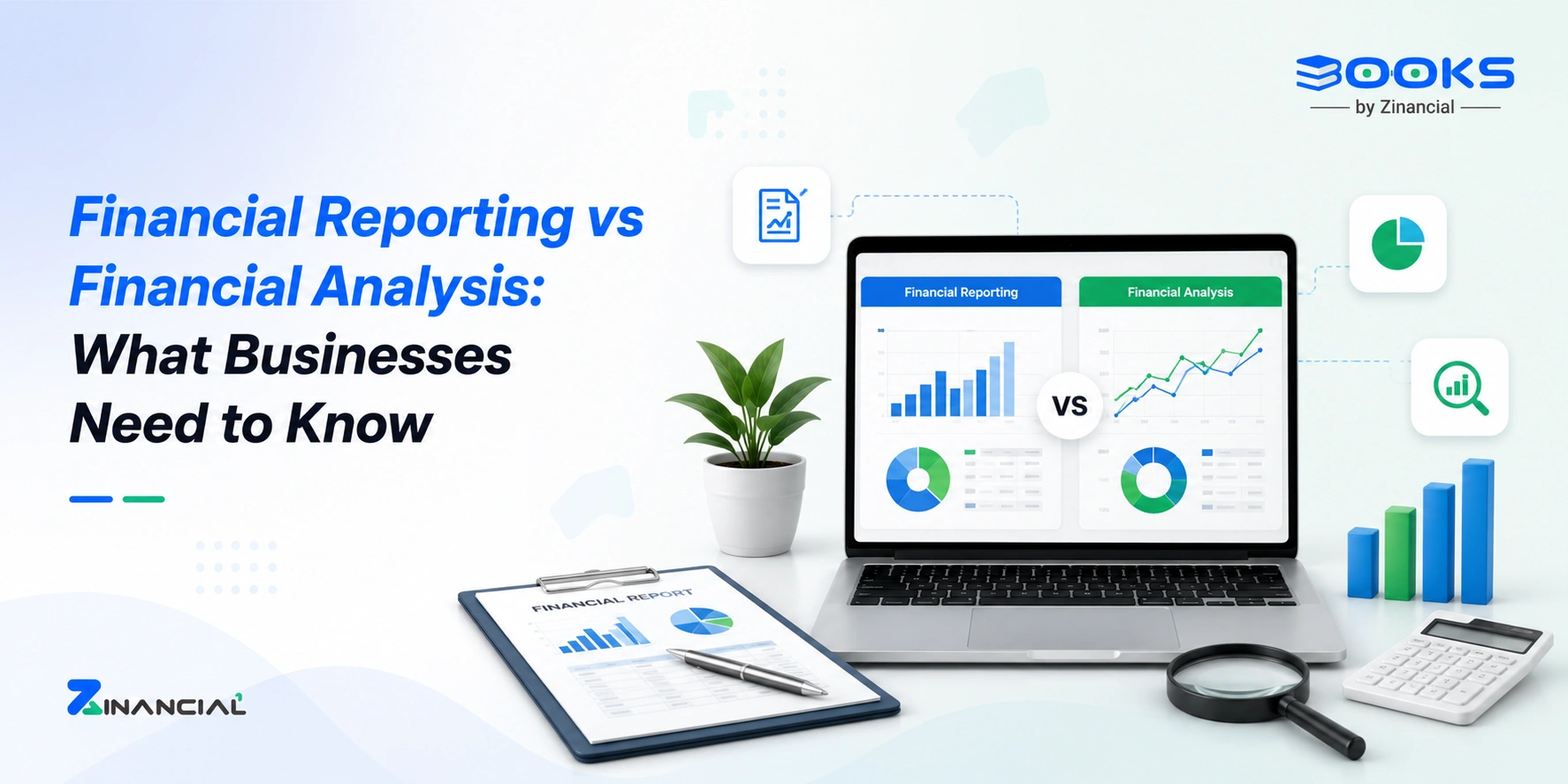
Financial Reporting vs Financial Analysis: What Businesses Need to Know

Vikas Vishwakarma
Written byZinancial TeamEdited on 18 Sep, 2026
Financial Reporting vs Financial Analysis: What Businesses Need to Know
Article summary

Article Summary

This should save you ~10 minutes of reading

This article explains the differences between financial reporting and analysis and why both are essential for effective financial management.

It covers the purpose of financial reporting, which is preparing accurate financial statements, and financial analysis, which interprets that data to support strategic decisions.

It also highlights the role of management reporting in providing internal business insight, explains who owns each function, and shows when financial analysis matters most.

Businesses generate large volumes of financial data every day. But raw numbers alone don’t help leaders make decisions. This is where understanding financial reporting vs financial analysis becomes important.

Both processes deal with the same underlying financial data, yet they serve different purposes. Financial reporting focuses on presenting structured financial statements. Financial analysis interprets those numbers to guide strategy. Think of it like a weather forecast: reporting is the raw data collected from weather stations, things like temperature, humidity, and wind speed, while analysis is the meteorologist’s interpretation of that data to predict tomorrow’s forecast. Without accurate reporting, analysis has nothing reliable to work from.

Many companies confuse the two, or treat them as interchangeable. When reporting and analysis get mixed up or misunderstood, decision-making slows down and businesses end up reacting to problems instead of anticipating them.

Let’s break down how financial reporting and financial analysis differ in practice, and how businesses should use them together.

What Is Financial Reporting?

Financial reporting is the process of collecting, organizing, and formally presenting financial information in a standardized format. It documents the financial performance of a business during a specific period, and its output usually appears as formal financial statements used by internal teams, investors, regulators, and auditors.

Common financial statements and financial reports include:

  • Balance sheet
  • Income statement (profit and loss statement)
  • Cash flow statement
  • Statement of changes in equity

The primary goal of financial reporting is accuracy and compliance. It’s a backward-looking process that answers questions such as:

  • What revenue did the company generate?
  • What expenses were incurred?
  • What assets and liabilities exist today?

Because of this, financial reporting typically follows recognized accounting frameworks such as GAAP (Generally Accepted Accounting Principles) in the US or IFRS (International Financial Reporting Standards) internationally, along with other statutory requirements set by bodies like the SEC or IRS.

However, reporting alone doesn’t explain why numbers changed or what decisions should follow. It simply presents the data. This is where financial analysis and management reporting begin to play a critical role.

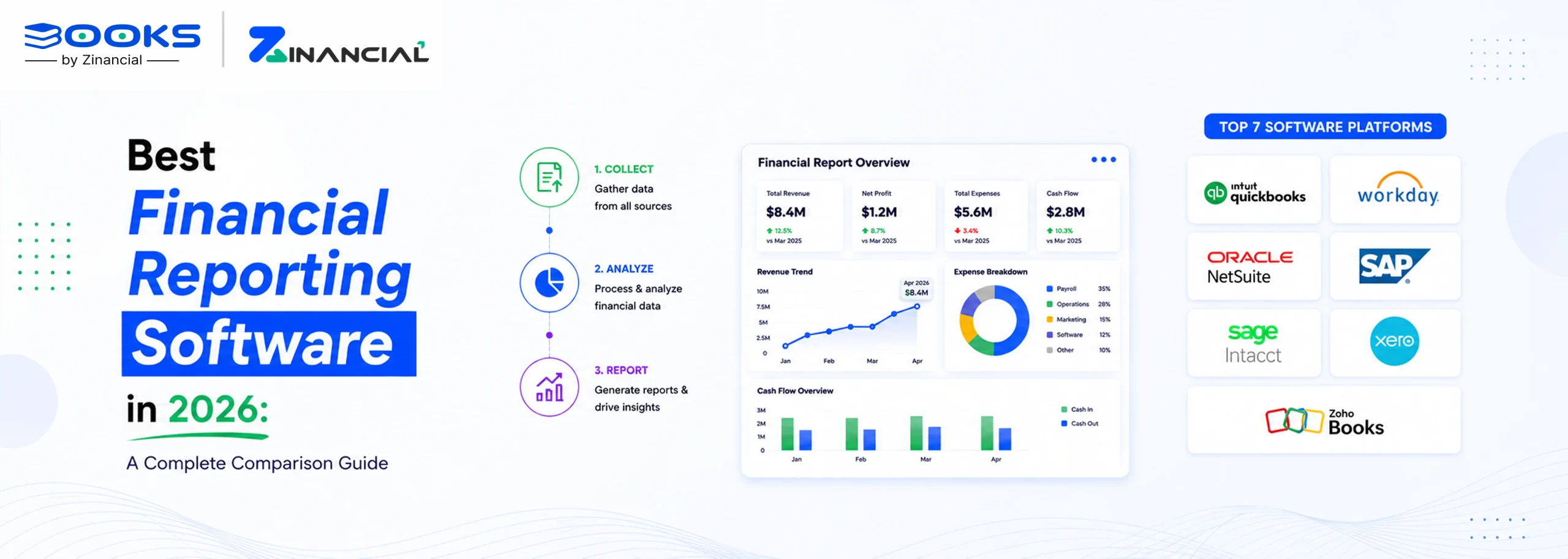
Also Read: Best Financial Reporting Software in 2026

See Your Financial Story, Not Just the Numbers

Move beyond static reports. Zinancial Books turns your transaction data into real time financial analysis so you always know what’s driving your numbers.

Explore Financial Analysis

What Is Financial Analysis?

While financial reporting presents financial data, financial analysis focuses on interpreting it. If reporting is the “what,” analysis is the “why” and “what’s next.”

A financial analyst or FP&A (Financial Planning & Analysis) team studies financial statements to understand trends, performance patterns, and potential risks in a company’s financial performance. Instead of asking what happened, they ask why it happened and what it means going forward.

This process involves several techniques:

  • Ratio analysis
  • Trend and horizontal analysis
  • Vertical analysis
  • Variance analysis
  • Scenario and sensitivity analysis
  • Forecasting and projections

For example, if profit margins decline, financial analysis investigates the reasons. It may reveal rising operational costs, pricing changes, or declining sales performance. At this stage, finance teams connect financial data with operational performance to understand what actually drives results.

Key questions answered through financial analysis include:

  • Is the business financially stable?
  • Which departments drive profitability?
  • What risks may affect future growth?
  • Is this the right time for an investment or expansion decision?

Without analysis, financial reports remain static documents. They’re accurate, but silent on what to do next.

Financial Reporting vs Financial Analysis: The Core Difference

Understanding the difference between financial reporting and financial analysis becomes easier when you compare their objectives side by side.

Aspect Financial Reporting Financial Analysis
Purpose Present financial information Interpret financial performance
Focus Historical data Insights and future decisions
Nature Structured and standardized Flexible and interpretive
Output Financial statements Strategic insights and recommendations
Audience Regulators, investors, auditors Management and decision-makers
Time Orientation Past-focused Forward-looking
Approach Structured documentation Evaluation and interpretation

In simple terms, financial reporting vs financial analysis comes down to the difference between data presentation and data interpretation.

  • Reporting answers: “What happened?”
  • Analysis answers: “Why did it happen, and what should we do next?”

Businesses need both. Reporting provides accuracy and transparency, while analysis enables strategic action. Neither one is optional, and neither one is a substitute for the other.

One Platform for Reporting and Analysis

Stop switching between spreadsheets and disconnected tools. Get accurate financial statements and management reporting dashboards in one place, built to scale with your business.

Get Started Free

Who Owns Financial Reporting vs Financial Analysis?

The two functions are usually handled by different people, which is part of why the differences between financial reporting and analysis matter operationally, not just conceptually.

  • Financial reporting is typically owned by accountants and bookkeepers, whose focus is on accuracy, reconciliation, and compliance with corporate finance standards.
  • Financial analysis is usually performed by a financial analyst or an FP&A team, whose job is to interpret the numbers, build models, and turn financial data analysis into recommendations for leadership.

Beyond the finance function itself, both processes serve a wider set of stakeholders: regulators and tax authorities who need compliance data, lenders and investors assessing repayment or return potential, and internal managers and department heads who rely on both functions to run day-to-day financial management decisions.

How Management Reporting Connects Reporting and Analysis

Between formal financial reporting and deep financial analysis, there’s another important layer: management reporting.

Management reports are designed specifically for internal leadership teams. They summarize financial performance while also highlighting insights needed for operational decisions. These reports typically include:

  • Budget vs. actual comparisons
  • Department-wise spending reports
  • Cash flow forecasts
  • KPI dashboards

Unlike statutory financial statements, management reporting focuses on clarity and speed. It helps executives answer practical questions such as:

  • Which business units are profitable?
  • Are we overspending in any department?
  • How will current trends impact future revenue?

Many organizations now automate management reporting through financial reporting and analysis software, converting raw transaction data into structured internal reports that support financial planning and strategic decision-making. This layer bridges the gap between pure reporting and deeper analysis, and it’s often where growing businesses get the most immediate value.

Why Businesses Need Both Reporting and Analysis

The most effective finance teams combine structured financial reporting with financial analysis to guide decisions and improve financial performance. A useful way to think about it: a company that only reports its numbers is like a ship captain who only watches the speedometer. They know their speed, but not whether they’re on course, whether a storm is ahead, or whether the engine is holding up.

Here’s how the two functions work together:

1. Reporting creates a reliable data foundation. Accurate financial reporting creates the foundation that financial analysis depends on. Without structured financial statements, analysis becomes guesswork.

2. Analysis converts data into decisions. Once financial data is available, a financial analyst interprets it to guide leadership decisions in areas such as investment planning, cost control, and revenue optimization.

3. Reporting enables transparency. Investors, regulators, and stakeholders rely on financial reports to assess company performance. Clear reporting builds trust and accountability.

4. Analysis drives strategic growth. Through financial data analysis, companies identify opportunities and risks earlier, for example by discovering declining margins in a product category or detecting cash flow challenges before they become critical.

According to a survey by PwC, 83% of companies have already implemented automation or digital solutions in parts of their finance functions. Financial reporting and analysis software like Zinancial Books helps businesses unify reporting and analysis so finance teams can focus more on insights rather than manual data preparation.


When Financial Analysis Matters Most

Financial analysis isn’t something businesses only need once a year at tax time. It becomes critical in specific, recurring situations:

  • Forecasting for a new product or service launch, where analysis helps estimate profitability, break-even points, and pricing strategy.
  • Performance reviews, where variance analysis pinpoints which departments are over budget or which product lines are underperforming and why.
  • Periods of rapid growth or economic uncertainty, when quick, informed decisions matter more than ever and monthly reporting cycles are too slow.
  • Evaluating an investment or expansion decision, where ratio analysis and forecasting reveal whether the expected return justifies the risk.

Common Mistakes Businesses Make

Many organizations struggle with the difference between financial reporting and financial analysis. This leads to several avoidable operational challenges.

1. Treating reporting as analysis. Some companies believe generating financial statements equals insight. In reality, reports only show numbers. Without financial analysis, leadership can’t interpret performance trends or act on them.

2. Relying on spreadsheets for analysis. Manual spreadsheets slow down financial data analysis and increase errors. Finance teams often struggle to maintain accuracy and consistency when managing data across multiple files.

3. Lack of real-time visibility. Traditional reporting cycles often run monthly or quarterly, which delays leaders from responding quickly to financial performance changes. Automated systems allow finance teams to run management reporting and analysis on demand.

4. Disconnected financial data. When financial data lives across multiple systems, reporting becomes fragmented. Unified financial reporting and analysis software solves this by centralizing transaction data and enabling accurate reporting and analysis in one place.

How Technology Is Changing Financial Reporting and Analysis

Finance teams are shifting from manual reporting toward automated financial analysis. Deloitte’s Finance Trends survey for 2026 found that 63% of finance leaders have fully deployed and actively use AI solutions in their finance functions.

Modern financial reporting and analysis software now offers:

  • Automated financial statement generation
  • Real-time management reporting dashboards
  • Built-in ratio analysis and financial ratios
  • Cash flow forecasting tools
  • AI-assisted financial data analysis

With these tools, companies no longer need separate systems for reporting and insights. Solutions like Zinancial Books combine accounting automation with advanced financial analysis, letting finance teams focus on strategy rather than data compilation. As businesses scale, this integrated approach to financial reporting and analysis becomes essential for maintaining clarity and control.

Turn Financial Data Into a Strategic Advantage

Understanding financial reporting vs financial analysis is essential for modern businesses. Reporting ensures accuracy, transparency, and compliance. Analysis transforms that information into insight, strategy, and growth opportunities.

When companies combine structured financial reporting and analysis with deep interpretation, finance teams move beyond bookkeeping and become strategic advisors. Platforms like Zinancial Books help organizations bring reporting, management reporting, and financial analysis into a single system, making financial data easier to understand and act on.

Try Zinancial Books Free for 30 Days

Experience automated financial reporting, management reporting, and financial analysis with no commitment. Start your 30 day free trial today and see the difference for yourself.

Start Your Free Trial

FAQs
Frequently Asked Questions

Quick answers to common questions about this topic.

What is the difference between financial reporting and financial analysis?

Financial reporting documents what happened during a period through financial statements like the income statement, balance sheet, and cash flow statement. Financial analysis interprets that record to explain why it happened and what it means for the future. Reporting answers "what happened," while analysis answers "why it happened and what to do next."

Why is financial analysis important for a business?

A financial statement showing revenue growth doesn't tell you whether that growth was profitable, which segments drove it, or whether it will hold. Financial analysis answers those questions, turning historical data into the basis for pricing decisions, hiring plans, and investment choices.

What are the main financial statements used in financial reporting?

The core financial statements are the income statement (revenue, expenses, and net income over a period), the balance sheet (assets, liabilities, and equity at a point in time), and the cash flow statement (cash movement across operating, investing, and financing activities). Many businesses also prepare a statement of changes in equity.

What financial ratios are commonly used in financial analysis?

Common financial ratios fall into four categories: liquidity ratios (current ratio, quick ratio), profitability ratios (gross margin, operating margin, net margin), efficiency ratios (inventory turnover, accounts receivable turnover), and leverage ratios (debt-to-equity, interest coverage).

How does Zinancial Books support financial reporting and analysis?

Zinancial Books automates financial reporting by generating accurate financial statements, including balance sheets, income statements, and cash flow reports, directly from real-time accounting data, while also organizing that data into dashboards for deeper financial analysis.

Does Zinancial Books provide management reporting features?

Yes. Zinancial Books offers management reporting tools that generate real-time internal reports, helping business leaders monitor financial performance, track KPIs, and make strategic decisions.

Is Zinancial Books suitable for growing businesses?

Yes. Zinancial Books is designed to scale with growing businesses, supporting both financial reporting and financial analysis through automated reporting and real-time financial data analysis.

Still have questions?

We are here to answer any question you may have.

Ask a Question

Our Recent Blog

5 Best Financial Statement Generator for Startups & SMBs in 2027
26 Oct, 2026Books

5 Best Financial Statement Generator for Startups & SMBs in 2027

A financial statement generator helps turn accounting data into clear reports, so you can understand your business finances without spending hours sorting through spreadsheets. For startups and SMBs, the right tool can simplify reporting, reduce manual work, and help answer important questions about profitability, cash flow, and financial health. However, features, accuracy, and costs vary […]

Read More...
Best Financial Reporting Software for 2027: 10 Tools Compared (With Pricing)
12 Aug, 2026Books

Best Financial Reporting Software for 2027: 10 Tools Compared (With Pricing)

If you have ever stayed late closing the books, you know the drill. You pull numbers from five different tabs and cross-check formulas that break the moment someone edits a cell. You send the report to your boss, then find an error an hour later. Financial reporting software exists to end that cycle. The right […]

Read More...
Top 7 Expense Reporting Software Platforms in 2026
7 Aug, 2026Books

Top 7 Expense Reporting Software Platforms in 2026

You have paid for lunch with a client, uploaded the receipt, and submitted your expense report. Days later, it is still awaiting approval, reimbursement is delayed, and finance is following up on missing details. Expense reporting software is designed to eliminate those bottlenecks. It automates receipt capture, approvals, and expense tracking, helping businesses save time […]

Read More...
Engineered by the Best in the Business - Zinancial call to action banner

Engineered by the Best in the Business

Zinancial is built by professionals who understand accounting challenges, modern software, and especially what growing businesses need.