Zinancial

Get Early Access at $25/month

Zinancial Books
Featured Blog

What Is Cash Flow Management? A Beginner’s Guide for Businesses

Vibudh Upadhyay
Written byZinancial TeamEdited on 16 Sep, 2026
What Is Cash Flow Management? A Beginner’s Guide for Businesses
Article summary

Article Summary

This should save you ~10 minutes of reading

Cash flow management tracks how money moves in and out of your business — separate from profit, since a company can be profitable on paper and still run out of cash.

Not the same as profit: cash flow is real money available now; profit is revenue minus expenses on paper.

3 types: operating, investing, and financing cash flow.

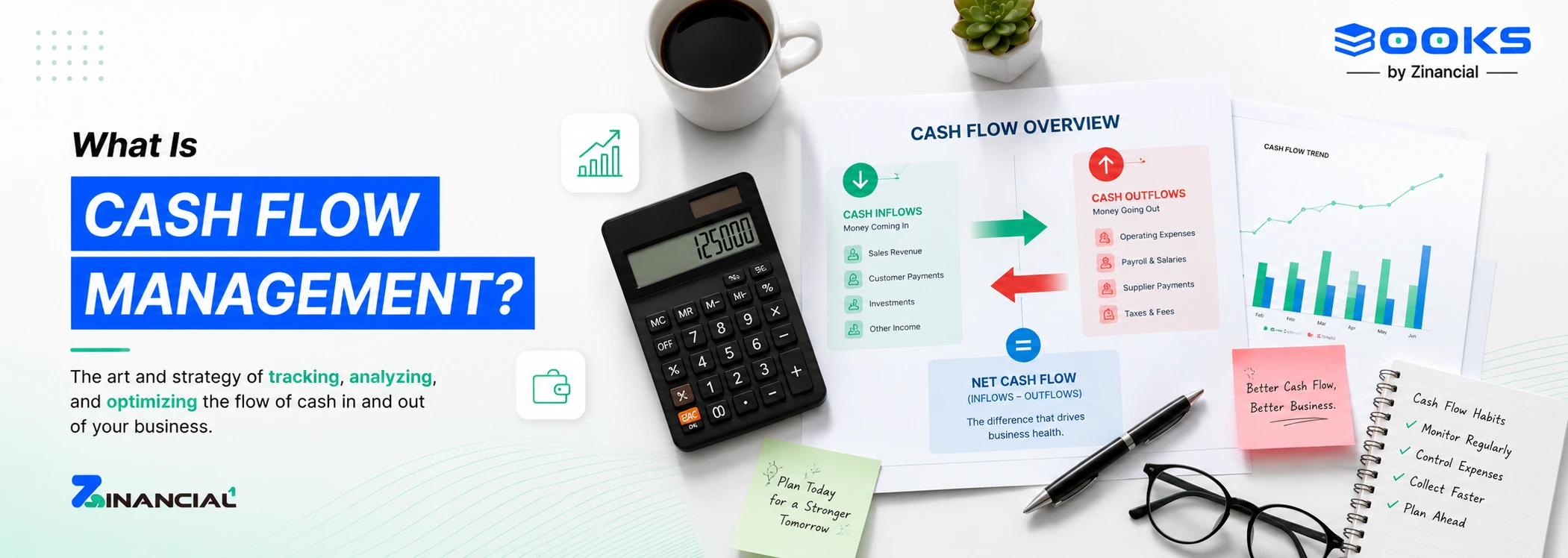
Cash flow management is the practice of monitoring, analyzing, and optimizing how money moves in and out of your business. It’s different from profit — your company can be profitable but still struggle with day-to-day payments. Cash flow tracking gives you a clear, real-time picture of available funds, helping you make informed decisions.

In simple terms, cash flow management in business means making sure you always have enough cash on hand to cover what you owe — payroll, rent, suppliers — regardless of how much revenue shows up on your income statement.

The 3 Types of Cash Flow

Every dollar moving through your business falls into one of three categories. Understanding the difference helps you see exactly where cash is coming from — and where it’s going.

Operating cash flow: Cash generated from your core business activities — money from sales, minus day-to-day expenses like payroll, rent, and supplier payments. This is the clearest signal of whether your actual operations are self-sustaining.

Investing cash flow: Cash used for or generated from long-term investments — buying equipment, property, or other assets. Fast-growing companies often see negative investing cash flow, which isn’t a bad sign; it usually means they’re investing in growth.

Financing cash flow: Cash tied to how your business is funded — money from loans, investors, or debt repayment. A positive financing cash flow can mean healthy investment, but relying on it to cover daily operations can be a warning sign.


Why Is Cash Flow Important?

Managing cash is not just about preventing overdrafts. Effective cash flow management ensures your business can meet obligations, invest in growth, and withstand financial shocks.

Here is what it accomplishes:

  • Predict shortfalls: Identify when expenses may exceed incoming revenue.
  • Optimize spending: Allocate resources to high-impact areas efficiently.
  • Support growth: Free up funds for new projects, hires, or technology.
  • Improve vendor relationships: Timely payments strengthen partnerships.

According to the U.S. Chamber of Commerce, cash flow problems are one of the most common reasons small businesses struggle — even when they’re profitable on paper. Without structured cash flow tracking, businesses often react to issues instead of preventing them. For startups, small delays in invoicing or unexpected payments can create a cash crunch, even if overall sales are growing.

Core Components of Cash Flow Management

Understanding what cash flow management is requires breaking it into actionable components. Each part contributes to a complete picture of your business cash flow.

Component What It Does Why It Matters
Cash Inflows Tracks revenue from sales, loans, or investments Ensures funds are sufficient to cover expenses
Cash Outflows Monitors supplier payments, salaries, taxes Prevents overdrafts and late fees
Forecasting Projects future cash positions Helps plan for slow periods or growth initiatives
Liquidity Planning Keeps reserves for emergencies Avoids disruption from unexpected costs
Reporting Generates daily, weekly, or monthly summaries Supports informed financial decisions

Each element requires cash flow tracking to ensure accuracy. Missing even one piece can create gaps in visibility, leading to risky assumptions about available funds.

Cash Flow Management for Startups

For startups, cash flow management is often a matter of survival, not just good practice. New businesses operate on tight budgets, face delayed customer payments, and require constant reinvestment.

Key startup strategies include:

  • Prioritize essentials: Rent, payroll, and key suppliers first.
  • Invoice promptly: Faster billing reduces waiting periods for cash inflow.
  • Negotiate terms: Extend vendor payments where possible without penalties.
  • Monitor your burn rate: Keep a close eye on how fast funds are spent.
  • Plan for contingencies: Always maintain a small cash reserve.

Here’s what this looks like in practice: a startup closes a $40,000 deal with 30-day payment terms, but rent, payroll, and vendor invoices are due in two weeks. Even though the company is profitable on paper, it may not have the cash on hand to cover those bills until the invoice is paid. Startups that track cash flow weekly — not just monthly — catch gaps like this before they become a crisis.

Startups frequently underestimate the need for structured cash flow tracking. Even with growing sales, unexpected spikes in expenses can create financial stress. A dashboard that visualizes inflows and outflows can prevent such situations and enable timely decisions.

Techniques for Effective Cash Flow Tracking

Proper cash flow tracking is a practical step toward stable finances. Techniques vary depending on business size and complexity.

  • Daily monitoring: Track deposits, withdrawals, and pending payments daily.
  • Categorize transactions: Group expenses into payroll, operations, marketing, etc.
  • Use digital tools: Automate tracking to minimize manual errors.
  • Set alerts: Receive notifications for low balances or overdue invoices.
  • Regular reconciliation: Ensure records match bank statements for accuracy.

Many businesses simplify this by using cash flow management software that combines tracking, alerts, and categorization in one place — reducing the need for multiple spreadsheets.

Cash Flow Formulas You Should Know

Formulas won’t replace judgment, but they give you a fast, objective read on your cash position.

Net Cash Flow

Net Cash Flow = Total Cash Inflows − Total Cash Outflows

Tells you, in the simplest terms, whether your business generated or burned cash in a given period.

Operating Cash Flow

Operating Cash Flow = Net Income + Non-Cash Expenses (e.g., depreciation) ± Changes in Working Capital

Shows whether your core business activities — not financing or one-time asset sales — are generating enough cash to sustain operations.

Common Challenges in Cash Flow Management

Even experienced businesses face hurdles in cash flow management. Recognizing them early prevents disruption.

  • Late payments from clients: Reduce by sending reminders and offering multiple payment options.
  • Unexpected expenses: Maintain an emergency fund to cover sudden costs.
  • Over-reliance on credit: Borrowing to cover gaps can lead to debt cycles.
  • Poor forecasting: Without accurate projections, decision-making becomes reactive.
  • Manual tracking errors: Paper-based systems or spreadsheets are prone to mistakes.

Each challenge highlights the importance of continuous cash flow tracking. By identifying weak points, you can implement safeguards and optimize operations.

In PwC’s 2025 Global Treasury Survey of 350 senior treasury professionals, 52% of mid-sized companies still rely on manual data collection for cash forecasting — a sign that real-time visibility remains a challenge even at well-resourced organizations.

How to Forecast Business Cash Flow

Forecasting is an essential part of cash flow management. It allows you to anticipate shortfalls, plan investments, and reduce stress.

Steps to forecast business cash flow:

  • Gather historical data: Review previous months for patterns.
  • Estimate inflows: Include sales, loans, or expected investments.
  • Predict outflows: Factor in salaries, rent, taxes, and recurring costs.
  • Adjust for seasonality: Consider high and low sales periods.
  • Update regularly: Keep forecasts current to respond to changes quickly.

By maintaining a rolling forecast, businesses can avoid surprises and make informed funding decisions.

Benefits of Investing in Cash Flow Management Software

Modern software simplifies cash flow management. Tools automate calculations, generate alerts, and provide real-time insights.

Benefits include:

  • Time savings: Automates repetitive tracking tasks.
  • Accuracy: Reduces human errors in records.
  • Transparency: Provides clear visibility for all stakeholders.
  • Decision support: Facilitates strategic planning and resource allocation.
  • Scalability: Adapts as business volume grows.

Investing in the right cash flow management software turns tracking from a tedious task into a strategic advantage — giving teams real-time visibility, automated tracking, and clearer control over cash decisions. Zinancial Books offers all of this in one dashboard, built specifically for teams that want to stop chasing spreadsheets. Start a free trial →

Start Managing Your Cash Flow Early

Effective cash flow management determines whether your business thrives or struggles. Implementing structured cash flow tracking, forecasting future inflows and outflows, and keeping a close eye on expenses ensures you stay in control.

Take practical steps: review your cash position, categorize expenses, set alerts for critical payments, and maintain reserves for unexpected costs. Startups should prioritize essentials and invoice promptly, while established businesses benefit from regular reconciliation and forecasting.

Sign up for Zinancial Books and gain full control over your cash flow today.

FAQs
Frequently Asked Questions

Quick answers to common questions about this topic.

What do you mean by cash flow management?

It's the process of tracking and controlling the money moving in and out of your business to stay financially stable.

What are five rules of cash flow?

Track your numbers, invoice promptly, spend less than you earn, keep a cash reserve, and forecast ahead.

What are three types of cash flows?

Operating, investing, and financing cash flow.

How do small businesses manage cash flow?

By tracking income and expenses regularly, invoicing fast, and using software to automate the process.

How to explain cash flow to dummies?

It's simply the money coming in minus the money going out of your business.

Can you explain cash flow in a simple way?

Cash flow is your business's money in motion — what comes in from sales and what goes out in bills.

Can you give me an example of a cash flow?

A $40,000 sale with 30-day payment terms, but rent and payroll due in two weeks — that gap is a cash flow issue.

What is considered a good cash flow?

Consistently more cash coming in than going out, with enough reserve to cover a few months of expenses.

What are common mistakes in cash flow analysis?

Confusing profit with cash flow, forecasting too optimistically, and ignoring payment timing gaps.

Still have questions?

We are here to answer any question you may have.

Ask a Question

Our Recent Blog

5 Best Financial Statement Generator for Startups & SMBs in 2027
26 Oct, 2026Books

5 Best Financial Statement Generator for Startups & SMBs in 2027

A financial statement generator helps turn accounting data into clear reports, so you can understand your business finances without spending hours sorting through spreadsheets. For startups and SMBs, the right tool can simplify reporting, reduce manual work, and help answer important questions about profitability, cash flow, and financial health. However, features, accuracy, and costs vary […]

Read More...
Best Financial Reporting Software for 2027: 10 Tools Compared (With Pricing)
12 Aug, 2026Books

Best Financial Reporting Software for 2027: 10 Tools Compared (With Pricing)

If you have ever stayed late closing the books, you know the drill. You pull numbers from five different tabs and cross-check formulas that break the moment someone edits a cell. You send the report to your boss, then find an error an hour later. Financial reporting software exists to end that cycle. The right […]

Read More...
Top 7 Expense Reporting Software Platforms in 2026
7 Aug, 2026Books

Top 7 Expense Reporting Software Platforms in 2026

You have paid for lunch with a client, uploaded the receipt, and submitted your expense report. Days later, it is still awaiting approval, reimbursement is delayed, and finance is following up on missing details. Expense reporting software is designed to eliminate those bottlenecks. It automates receipt capture, approvals, and expense tracking, helping businesses save time […]

Read More...
Engineered by the Best in the Business - Zinancial call to action banner

Engineered by the Best in the Business

Zinancial is built by professionals who understand accounting challenges, modern software, and especially what growing businesses need.